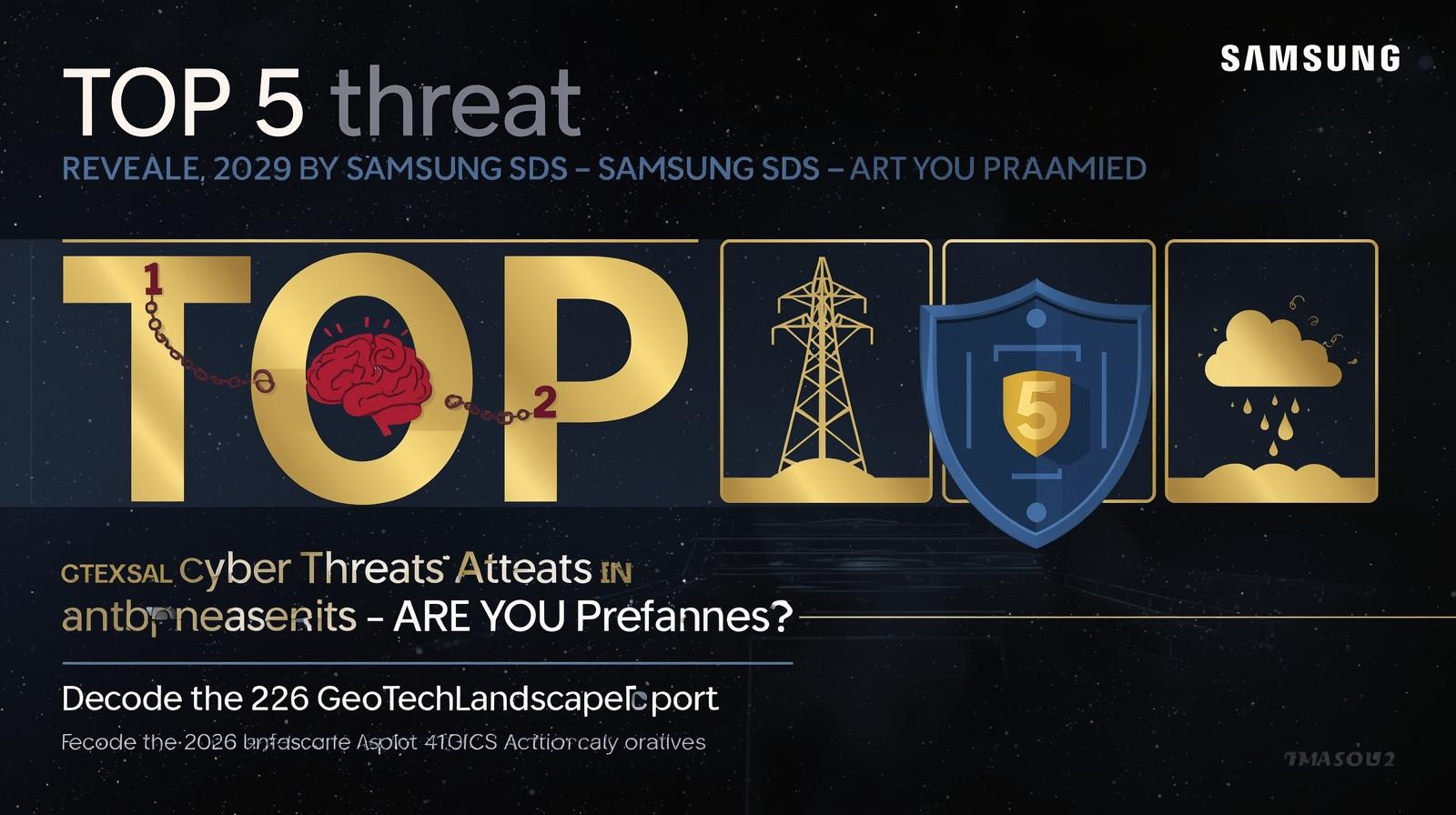
Introduction: The 2026 Threat Landscape, Mapped
On February 25, 2026, Samsung SDS published its annual cybersecurity forecast outlining the Top 5 Cybersecurity Threats for 2026. As the IT services and systems integration arm of Samsung Group, Samsung SDS operates across global enterprise environments — giving it real-world visibility into attack telemetry, infrastructure weaknesses, and industry-wide patterns.
Unlike speculative predictions, this report reflects observed adversary behavior across sectors including manufacturing, finance, logistics, and critical infrastructure.
For CISOs and enterprise risk leaders, the Samsung SDS cybersecurity threats 2026 forecast is not a headline list — it’s a strategic planning input.
Below, we translate each threat into plain-language risk intelligence and pair it with a prioritized defense checklist aligned to NIST and Zero Trust principles.
Threat #1: AI-Powered Attacks – The Mainstreaming of Machine Malice
From Novelty to Operational Weapon
Samsung SDS identifies AI-powered attacks as the defining threat of 2026. AI is no longer experimental in cybercrime — it is embedded across the attack lifecycle:
- Hyper-personalized phishing emails trained on scraped social data
- Adaptive malware that modifies behavior to evade detection
- Automated vulnerability discovery in large codebases
- Synthetic identity creation at scale
This aligns with warnings from agencies such as Cybersecurity and Infrastructure Security Agency (CISA) and recent industry threat intelligence reports.
Real-World Example: Deepfake Executive Fraud
One increasingly documented tactic involves AI-generated voice cloning.
Attackers impersonate CFOs or CEOs in real-time calls to authorize urgent wire transfers. Because the voice sounds authentic, traditional verification breaks down.
These “deepfake BEC” (business email compromise) schemes combine social engineering with generative AI realism.
Counterpoint: AI as Defense
AI is also becoming the most effective defensive tool:
- Behavioral anomaly detection
- Automated SOC triage
- AI-driven phishing detection
- Threat hunting copilots
The organizations that weaponize AI defensively will be best positioned to counter AI-driven offense.
Threat #2: Ransomware Evolution – Beyond Encryption to Extortion
Double and Triple Extortion as Standard Practice
The ransomware model continues to mature. Samsung SDS highlights the shift from simple encryption to:
- Data exfiltration
- Public leak site shaming
- DDoS amplification
- Regulatory pressure tactics
This evolution mirrors trends identified by European Union Agency for Cybersecurity (ENISA) in its annual threat landscape reporting.
Encryption is now secondary leverage. Data exposure is the primary weapon.
Precision Targeting Over Spray-and-Pray
Attackers are increasingly selective:
- Healthcare systems
- Critical infrastructure
- Energy providers
- Financial institutions
These sectors face catastrophic downtime risk — increasing ransom payment likelihood.
The ransomware evolution 2026 trend reflects strategic targeting, not opportunistic chaos.
Ransomware Economics
| Metric | 2024 | 2025 | 2026 (Projected) |
|---|---|---|---|
| Average ransom payment | $1.2M | $1.8M | $2.5M |
| % involving data theft | 45% | 68% | 85% |
| Recovery time (days) | 21 | 28 | 35 |
| Double extortion rate | 55% | 75% | 90% |
Source: Samsung SDS Threat Intelligence
Threat #3: Critical Infrastructure Under Siege
IT–OT Convergence Expands the Attack Surface
Samsung SDS warns of escalating risks to industrial control systems (ICS) and operational technology (OT) .
Converging IT and OT networks create new vulnerabilities:
- Legacy PLCs connected to modern networks
- Remote maintenance channels
- Cloud-linked monitoring systems
Air-gapped assumptions no longer hold.
Recent European energy-sector incidents underscore the fragility of connected infrastructure.
Unique Security Challenges
Critical infrastructure environments often struggle with:
- Outdated firmware
- Patch intolerance
- Long hardware lifecycle constraints
- Limited visibility tools
Security modernization lags digital transformation.
The result: high-impact attack potential.
Sector Risk Assessment
| Sector | Attack Surface | Impact Severity | Preparedness |
|---|---|---|---|
| Energy | Very High | Catastrophic | Low |
| Water | High | Severe | Low |
| Transportation | High | Severe | Medium |
| Healthcare | Very High | Critical | Medium |
| Manufacturing | High | Significant | Low-Medium |
Source: Samsung SDS Critical Infrastructure Risk Matrix
Threat #4: Supply Chain Compromise – The Weakest Link
Vendor Access as an Attack Vector
Supply chain compromise remains a persistent threat category.
Attackers increasingly target:
- Managed service providers
- Software vendors
- Third-party contractors
Compromising a small vendor can unlock access to dozens of enterprise customers.
Software Supply Chain Risks
Beyond vendor access, software integrity risks include:
- Malicious open-source library injections
- Dependency confusion attacks
- Compromised software updates
The complexity of modern software ecosystems makes full code provenance verification difficult.
Samsung SDS emphasizes that third-party risk management must become continuous, not periodic.
Supply Chain Attack Vectors
| Vector | Description | 2026 Trend |
|---|---|---|
| MSP Compromise | Attack managed service providers | Increasing |
| Open Source Poisoning | Malicious library insertion | Rapidly increasing |
| Update Hijacking | Compromise update mechanisms | Stable |
| Dependency Confusion | Public package takeover | Increasing |
| Hardware Implants | Physical supply chain | Low but persistent |
Threat #5: Identity and Access Management (IAM) as the New Perimeter
Identity Is the New Firewall
With cloud adoption and remote work normalized, the network perimeter has dissolved.
Attackers now focus on:
- Credential phishing
- Token theft
- MFA fatigue attacks
- SSO misconfigurations
Compromising identity often provides broader access than exploiting a server vulnerability.
Phishing-Resistant MFA and Passkeys
Security frameworks increasingly recommend phishing-resistant multi-factor authentication (MFA) , such as:
- FIDO2-based passkeys
- Hardware security keys
- Certificate-based authentication
Zero Trust architecture assumes breach — and continuously verifies identity context.
Samsung SDS highlights IAM resilience as a 2026 priority.
Identity Attack Trends
| Attack Type | 2024 | 2025 | 2026 (Projected) |
|---|---|---|---|
| Credential phishing | 45% | 52% | 60% |
| MFA bypass | 12% | 22% | 35% |
| Token theft | 18% | 25% | 32% |
| Session hijacking | 15% | 18% | 22% |
| Privilege escalation | 28% | 30% | 33% |
Percentage of organizations reporting incidents
Your 2026 Defense Playbook: Action Items for Each Threat
Forecasts matter only if they drive execution. Here is a prioritized response checklist aligned to National Institute of Standards and Technology (NIST) frameworks and Zero Trust guidance.
1. AI-Powered Attacks
| Priority | Action | Timeline |
|---|---|---|
| Critical | Deploy AI-enhanced detection platforms within SOC workflows | Q1 2026 |
| High | Implement out-of-band verification for financial approvals | Q1 2026 |
| High | Conduct executive deepfake awareness training | Q2 2026 |
| Medium | Test AI defense tools against known attack patterns | Q2-Q3 2026 |
2. Ransomware Evolution
| Priority | Action | Timeline |
|---|---|---|
| Critical | Maintain immutable, offline backups | Immediate |
| Critical | Test full recovery restoration quarterly | Ongoing |
| High | Validate cyber insurance coverage scope | Q1 2026 |
| High | Segment critical systems from general networks | Q2 2026 |
| Medium | Implement data leakage detection | Q2-Q3 2026 |
3. Critical Infrastructure Risks
| Priority | Action | Timeline |
|---|---|---|
| Critical | Segment IT and OT environments | Q1-Q2 2026 |
| Critical | Enforce strict remote access controls | Immediate |
| High | Conduct red-team exercises simulating ICS compromise | Q2 2026 |
| High | Implement continuous monitoring for industrial networks | Q2-Q3 2026 |
| Medium | Develop OT-specific incident response plans | Q3 2026 |
4. Supply Chain Compromise
| Priority | Action | Timeline |
|---|---|---|
| Critical | Mandate vendor security assessments | Immediate |
| High | Apply least-privilege access for third parties | Q1 2026 |
| High | Require SBOM (Software Bill of Materials) transparency | Q2 2026 |
| Medium | Monitor for software integrity anomalies | Q2-Q3 2026 |
| Medium | Conduct third-party penetration testing | Q3 2026 |
5. IAM as the New Perimeter
| Priority | Action | Timeline |
|---|---|---|
| Critical | Enforce phishing-resistant MFA | Q1 2026 |
| High | Monitor anomalous login behavior | Q1 2026 |
| High | Reduce standing privileges | Q1-Q2 2026 |
| High | Adopt Zero Trust identity validation | Q2 2026 |
| Medium | Implement just-in-time access | Q2-Q3 2026 |
Implementation Roadmap: From List to Program
Phase 1: Assessment (March 2026)
- Conduct gap analysis against each threat category
- Identify critical asset exposure
- Document current control effectiveness
- Prioritize remediation based on risk
Phase 2: Quick Wins (April-June 2026)
- Implement phishing-resistant MFA
- Segment highest-risk systems
- Validate backup integrity
- Conduct executive awareness training
Phase 3: Programmatic Investment (H2 2026)
- Deploy AI-enhanced detection
- Implement continuous vendor monitoring
- Build OT security capabilities
- Develop IAM maturity
Phase 4: Validation (Ongoing)
- Tabletop exercises for each threat scenario
- Red team assessments
- Third-party audits
- Board-level reporting
CISO Action Guide: Turning Forecast into Strategy
Questions for Your Team
- AI-Powered Attacks: Do we have visibility into AI-generated threats? Are we using AI defensively?
- Ransomware Evolution: Can we recover without paying? Have we tested this?
- Critical Infrastructure: Are OT and IT appropriately segmented? Do we monitor industrial networks?
- Supply Chain: Do we know our vendors’ security posture? Is it continuously monitored?
- IAM: Is MFA phishing-resistant? Are privileges managed proactively?
Metrics to Track
- Mean time to detect AI-powered attacks
- Backup recovery success rate
- OT asset visibility percentage
- Vendor risk assessment coverage
- MFA adoption rate (phishing-resistant)
Board-Level Talking Points
- “AI-powered attacks are now mainstream — we’re investing in defensive AI”
- “Ransomware has evolved; we’ve validated our recovery capabilities”
- “Critical infrastructure risk requires OT/IT segmentation”
- “Supply chain risk is continuous, not annual”
- “Identity is the new perimeter — we’re implementing phishing-resistant MFA”
Expert Perspectives
From Samsung SDS
“The threat landscape for 2026 is defined by automation and targeting. AI enables attackers to operate at machine speed, while ransomware actors have perfected the art of pressure. Organizations must respond with equal sophistication — embedding security into architecture, not adding it as an afterthought.” — Samsung SDS Threat Intelligence Team
From Industry
“What stands out in this year’s forecast is the convergence of threats. AI-powered attacks enable ransomware at scale. Supply chain compromises target critical infrastructure. Identity failures expose everything. CISOs must think systemically, not categorically.” — Former CISO, Fortune 50 financial institution
From Government
“Samsung SDS’s findings align with our observed threat activity. We particularly echo the concern around critical infrastructure and the need for public-private partnership in defense. No organization can defend alone against state-backed actors targeting essential services.” — Senior official, cybersecurity agency
Conclusion: From Forecast to Fortification
The Samsung SDS cybersecurity threats 2026 forecast does not introduce surprises.
It highlights intensifying trends:
- AI weaponization
- Ransomware monetization refinement
- Infrastructure targeting
- Supply chain infiltration
- Identity exploitation
The organizations that treat this report as a roadmap — not a warning — will be positioned to withstand the next wave of attacks.
Threat forecasting is valuable only when it drives proactive investment, architecture redesign, and executive alignment.
Use this list as a gap analysis tool:
- Where are you overexposed?
- Where are you underinvested?
- Where are controls documented but not validated?
The 2026 threat environment is predictable in direction — if not in timing.
The question is not whether these threats will materialize. It’s whether your organization will be ready when they do.
📋 Turn forecast into action. Download our free “2026 Threat Readiness Assessment” workbook to benchmark your organization against Samsung SDS’s top five risks.
Related Resources
Internal Cyvack Guides
- CISA Warns of Rising Ransomware Exploits — Analysis and Response Framework
- Critical Infrastructure Cyberattacks in Europe — Lessons for Global Defenders
- Zero Trust Architecture in 2026: Why It’s Still Non-Negotiable
Official Samsung SDS Resources
- Samsung SDS Official Cybersecurity Forecast Report
- Samsung SDS Security Blog
- Samsung SDS Threat Intelligence Center
Government and Regulatory Sources
CISA (Cybersecurity and Infrastructure Security Agency)
- CISA Threat Advisories
- CISA Ransomware Guide
- CISA Critical Infrastructure Security
- CISA AI Security Considerations
ENISA (European Union Agency for Cybersecurity)
- ENISA Threat Landscape Report
- ENISA Cybersecurity for Critical Infrastructure
- ENISA Artificial Intelligence Cybersecurity
NIST (National Institute of Standards and Technology)
Industry Frameworks and Standards
- MITRE ATT&CK Framework
- ISO/IEC 27001 Information Security
- NIST SP 800-53 Security Controls
- CIS Critical Security Controls
Ready to act on the 2026 threat forecast? Contact Cyvack for strategic advisory, gap analysis, and implementation support.
